What Is the World's Biggest Snake?
BY ROBYN WHITE ON 1/24/22 AT 7:17 AM EST
01:55
10 Animals More Dangerous Than Sharks
SHAREShare on FacebookShare on TwitterShare on LinkedInShare on RedditShare on FlipboardShare via EmailComments
TECH & SCIENCESNAKEPYTHONNATUREANIMALS
Snakes are thought to have evolved from lizards, with the first specimens appearing in the fossil record during the Jurassic Period, between 143 and 167 million years ago. They diversified and modern snakes emerged after the extinction of the dinosaurs, 66 million years ago.
There are now more than 3,000 species of snake on the planet, with 600 of these being venomous.
They one of the most dangerous animals on Earth. The World Health Organization estimates that between 80,000 and 138,000 people die from snake bites each year.
According to National Geographic, snakes can be everywhere in the world except in Antarctica, Iceland, Ireland, Greenland, and New Zealand.
NEWSWEEK NEWSLETTER SIGN-UP >
The size of snakes varies widely between species, with the smallest measuring just four inches in length. But what of the biggest?
The longest snake
Graham Alexander, professor of herpetology at the University of Johannesburg, South Africa, told Newsweek that estimates of how long a snake is should always be taken "with a pinch of salt," as they are often exaggerated.
READ MORE
Enormous Python Swallows Even Bigger Impala in Horrifying Video
Watch Snake Catcher Trap Huge Python at Care Facility as People Shriek
Black Racer Snake Severely Entangled in Mesh Rescued by Florida Vets
NEWSWEEK SUBSCRIPTION OFFERS >
However, he said that no other snake can compete with the length of the reticulated python. "I've seen reticulated pythons in Southeast Asia that were significantly over 19 feet feet," he said. "They are massive snakes, without exaggerating."
The reticulated pythons average length is 20 feet, making it the longest snake in the world.
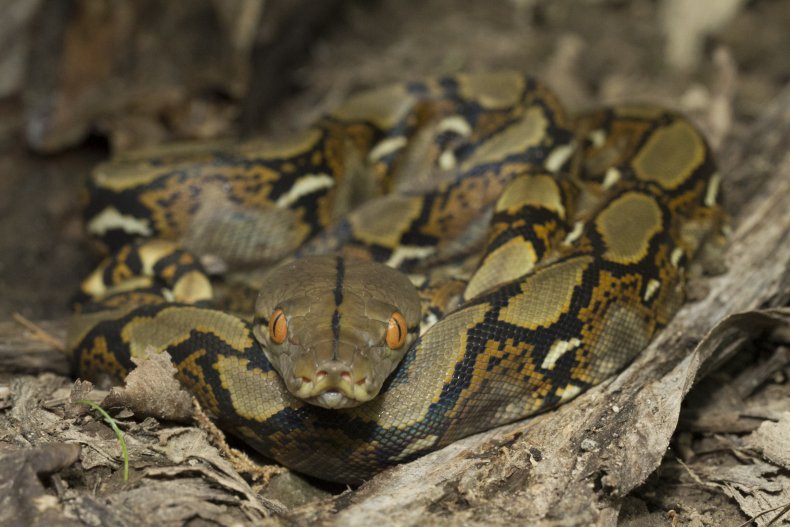 A stock photo shows a reticulated python. These snakes can be found in Asia and can measure about 20ft in length.DWI SEPTIYANA/GETTY IMAGES
It is native to South and Southeast Asia and can be found in rainforests, woodlands, and nearby grasslands. The python is a good swimmer and has in some instances been found far out to sea.
Alexander said: "We should remember that captive specimens may have the potential to reach larger sizes than wild ones on account of a steady food supply and a lack of predation in captivity.
"I do know that there are a couple of cases of Burmese python and reticulated python reaching lengths of around 26 feet in captivity. These are truly exceptional."
Pythons are non-venomous and kill their prey by suffocation. They use the momentum of a strike to wrap themselves around their victim, squeezing a little more tightly every time the prey exhales.
Alexander said that while pythons can be huge in length, the danger they pose tends to depend on their evolutionary history with humans: "Giant pythons in Asia, such as Burmese and reticulated Pythons, may on occasion view humans as a potential meal. They have not had the long evolutionary history with humans as African pythons have.
"In my opinion, African pythons exclude humans as prey because humans are just too dangerous—pythons that take humans usually end up dead, which has selected that taste out of the population. As with anecdotal reports on giant snakes in general, there is a lot of exaggeration."
01:55
10 Animals More Dangerous Than Sharks
SHAREShare on FacebookShare on TwitterShare on LinkedInShare on RedditShare on FlipboardShare via EmailComments
TECH & SCIENCESNAKEPYTHONNATUREANIMALS
Snakes are thought to have evolved from lizards, with the first specimens appearing in the fossil record during the Jurassic Period, between 143 and 167 million years ago. They diversified and modern snakes emerged after the extinction of the dinosaurs, 66 million years ago.
There are now more than 3,000 species of snake on the planet, with 600 of these being venomous.
They one of the most dangerous animals on Earth. The World Health Organization estimates that between 80,000 and 138,000 people die from snake bites each year.
According to National Geographic, snakes can be everywhere in the world except in Antarctica, Iceland, Ireland, Greenland, and New Zealand.
NEWSWEEK NEWSLETTER SIGN-UP >
The size of snakes varies widely between species, with the smallest measuring just four inches in length. But what of the biggest?
The longest snake
Graham Alexander, professor of herpetology at the University of Johannesburg, South Africa, told Newsweek that estimates of how long a snake is should always be taken "with a pinch of salt," as they are often exaggerated.
READ MORE
Enormous Python Swallows Even Bigger Impala in Horrifying Video
Watch Snake Catcher Trap Huge Python at Care Facility as People Shriek
Black Racer Snake Severely Entangled in Mesh Rescued by Florida Vets
NEWSWEEK SUBSCRIPTION OFFERS >
However, he said that no other snake can compete with the length of the reticulated python. "I've seen reticulated pythons in Southeast Asia that were significantly over 19 feet feet," he said. "They are massive snakes, without exaggerating."
The reticulated pythons average length is 20 feet, making it the longest snake in the world.
A stock photo shows a reticulated python. These snakes can be found in Asia and can measure about 20ft in length.DWI SEPTIYANA/GETTY IMAGESIt is native to South and Southeast Asia and can be found in rainforests, woodlands, and nearby grasslands. The python is a good swimmer and has in some instances been found far out to sea.
Alexander said: "We should remember that captive specimens may have the potential to reach larger sizes than wild ones on account of a steady food supply and a lack of predation in captivity.
"I do know that there are a couple of cases of Burmese python and reticulated python reaching lengths of around 26 feet in captivity. These are truly exceptional."
Pythons are non-venomous and kill their prey by suffocation. They use the momentum of a strike to wrap themselves around their victim, squeezing a little more tightly every time the prey exhales.
Alexander said that while pythons can be huge in length, the danger they pose tends to depend on their evolutionary history with humans: "Giant pythons in Asia, such as Burmese and reticulated Pythons, may on occasion view humans as a potential meal. They have not had the long evolutionary history with humans as African pythons have.
"In my opinion, African pythons exclude humans as prey because humans are just too dangerous—pythons that take humans usually end up dead, which has selected that taste out of the population. As with anecdotal reports on giant snakes in general, there is a lot of exaggeration."
Comments
Post a Comment